Amazon Unveils the Self-driven Robotaxi, Zoox that Drives on Public Roads in California with Employees on Board
 Facebook
 Twitter
 LinkedIn
 WhatsApp
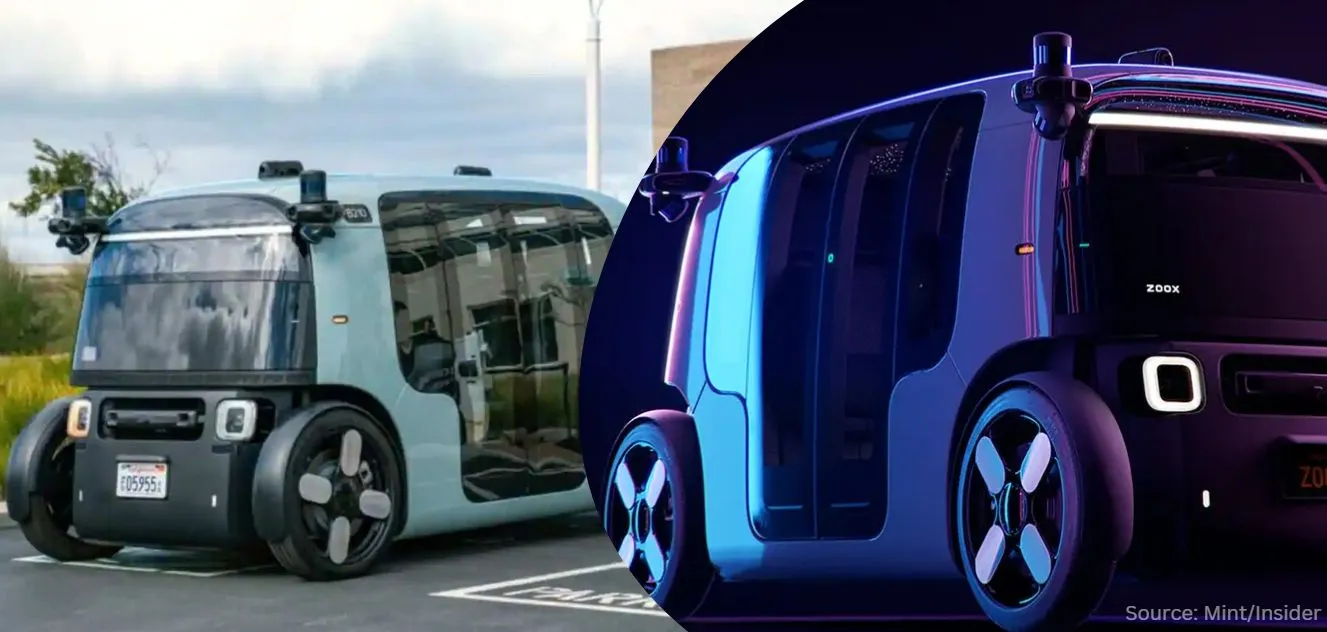
Imagine a robotaxi with no pedals or steering wheels, and self-driven with capabilities such as changing directions without being manned by a driver. Amazon-owned Zoox is just about this and more. It is currently being tested for only the employees of the headquarters of Zoox’s Foster City, California. The driverless autonomous vehicle was acquired by Amazon in 2000 from a 9-year-old startup. The automated taxi in question is carrying passengers on board with its bidirectional driving function, with no need to reverse, and contains four-wheel steering.
Last week, the Zoox company received approval for the tests from the California Department of Motor Vehicles. However, the permit is limited, and not possible for the robotaxi to drive on all the public roads in the state. The test drive is allowed only for shuttling employees between the two office buildings in the perimeter of the one-mile public route at the headquarter of the company in Foster City, California. The speed of the self-driven Zoox for this purpose is also permitted for up to 35 miles an hour.
Executives from Zoox have said that there are dozens of vehicles but the fleet size is less than 100. It also confirmed that over the weekend, the robotaxis completed a test run transporting the employees on board. Zoox came out with the electric robotaxi, a custom-built and on-demand autonomous transportation facility for operations in urban settings, as early as 2020, after which it was acquired by Amazon. At that time, the company had revealed just a few details on how the company’s technology would improve the robotaxi for the future.
But Zoox executives have not commented on anything as to if the vehicle is open for testing beyond the limit set for the route and participating employees, and when it will launch the said commercial robotaxi for public service. However, Zoox shall undergo several more tests with employees self-driven between the two buildings of the headquarters and perhaps launch the shuttle service in spring for its staffers.
Any vehicles in California that participate in testing on public roads have to report at each moment when the system disengages or a human driver controls the autonomous system on driving because of software issues and safety concerns. But Zoox does not report such incidents to the state as it refers to the events as something where the vehicle requires guidance or support and is not disengaged to shift to a human driver.
Aicha Evans, the Zoox CEO said that if the self-driven vehicle needs help for a situation it does not know to handle or do something that is normally not allowed, the scenario, in this case, is called a ‘fusion center’. Here, the vehicle is monitored by trained guidance operators to assess the scene and provide guidance to Zoox robotaxi, and then permit it to do something as the taxi does all the driving while still in charge, or as alternative trajectory drop breadcrumbs, or pull over at the worst.
The Cruise which is GM’s driverless unit also has – Origin, its autonomous shuttle without manual control. Last year, Alphabet’s Waymo along with Cruise got approval for their driverless taxi services in the state of California and offer their services to passengers, who will get charged for the rides. Unlike Cruise, Amazon-owned robotaxi says Zoox vehicles – which have no manual control and steering wheels, meet the Federal Motor Vehicle Safety Standards. Thus, the firm is not looking for waivers to put the vehicle on public roads for use.